1932: The Birth of a Tradition Inspired by Pamplona
The Fetes de Bayonne were born in 1932, inspired by the famous Sanfermines of Pamplona. A group of locals from Bayonne, after attending the Navarrese festival across the border, decided to create a similar event in their own city. The first rule was simple: white and red, as in Pamplona, but with a Bayonne identity. The inaugural edition attracted a few thousand participants. Today, the Fetes de Bayonne draw over one million visitors across five days, making it the largest street festival in France.
King Leon and the Opening of the Festivities
What sets the Fetes de Bayonne apart from the Sanfermines is the absence of bullfighting with a kill. While there are bull-related events, they consist mainly of course de vaches — young cows released into the arena or the streets — where the animal is never harmed. This distinction reflects Basque sensibility and has allowed the festival to modernize while preserving its popular, festive spirit.
The Bandas: The Musical Soul of the Festival
The starting signal for the festival is given by Roi Leon (King Leon), an iconic character whose giant effigy towers over the Place de la Liberte. On the first Thursday of August at 10 PM, King Leon throws the keys of the city from the town hall balcony, officially declaring the festivities open. At this signal, the crowd dressed in white and red erupts in joy, the bandas strike up their first tunes, and Bayonne tips into five days of non-stop celebration.
White and Red: A Sacred Dress Code
The origin of King Leon is itself a delightful story. The character was born from a popular Bayonne song whose catchy refrain became the unofficial anthem of the festival. Over the decades, King Leon has become a true symbol, a benevolent patron figure who presides over the collective revelry. His papier-mache effigy, renewed each year, is burned on the final evening during the closing ceremony, in a ritual that marks the end of the festival and the anticipation of the next.
The Fetes de Bayonne without music would be like pelota without a fronton. The bandas, those street orchestras made up of brass instruments, drums, and sometimes singers, are the sonic soul of the event. There are dozens of them, coming from across the southwest of France, and they parade through the streets from morning to night, sweeping the festayres along in joyful dances. Each banda has its own repertoire, its own style, and its own fans, and the most famous are genuine local celebrities.
The bandas' music is a surprising blend of Spanish paso doble, traditional Basque music, and popular hits. The musicians often play from memory, in a cheerful organized chaos that is the trademark of these marching orchestras. The atmosphere they create is unique: imagine hundreds of people dancing through the narrow lanes of Petit Bayonne to the sound of trumpets and tubas, beneath colorful streamers strung between the half-timbered houses.
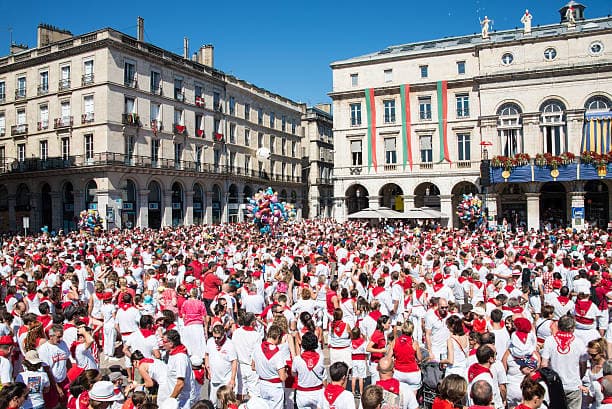
Wearing white and red during the Fetes de Bayonne is not optional — it is an imperative. White trousers, a white shirt, a red scarf tied around the neck, and a red sash at the waist make up the official outfit of the festayre. This dress code, directly inherited from the Sanfermines, creates a striking visual uniformity: seen from above, the festival crowd is a sea of white dotted with touches of red, a truly breathtaking sight.
It is strongly advised against attending the festival without following this dress code. Not only would you stand out immediately from the crowd, but you would also miss the experience of collective communion that the white and red make possible. The red scarf, in particular, is much more than an accessory: it is a symbol of belonging, a sign that you are fully embracing the spirit of the festival.