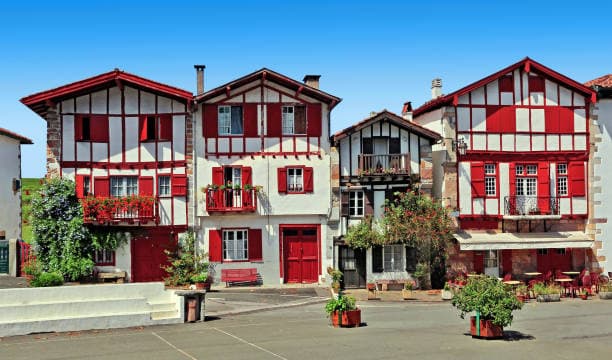
The Etxe: Far More Than a House — An Identity
In the Basque Country, a house is not simply a building. It carries a name — the etxe — and this name defines the family who lives there, not the other way around. Traditionally, the house gives its name to its occupants, rather than the family naming the house. A Basque person is first identified by their house of origin. This concept, deeply rooted in Basque culture, makes each dwelling a living monument, a tangible link between past and future generations.
The Secret of the Half-Timbering: Red, Green, or Blue?
This tradition dates back to the Middle Ages, when Basque customary law, known as the for, established the indivisibility of the family home. The etxe could neither be divided nor sold in parcels. It was passed down in its entirety to a single heir — the eldest child, whether male or female, as Basque law did not recognize male primogeniture. This legal principle, unique in Europe, shaped not only the architecture but the entire social organization of the Basque Country for centuries.
Facing East: An Ancestral Rule
The half-timbered beams of Labourdine houses are not painted at random. Traditionally, the ox-blood red — that distinctive Basque red — was the most common color. A mixture of actual ox blood and lime was used to protect the wood from the elements and insects. Green, found mainly in Lower Navarre and Soule, historically indicated belonging to a different province. Blue, which is rarer, was often associated with fishermen's houses along the coast.
The Lauburu and Symbols Carved on the Lintels
Beyond the colors, the arrangement of the timber framing itself tells the building's story. The cross-braced timbers in a Saint Andrew's cross pattern reinforce the structure and speak to the skill of local carpenters. The oldest houses feature a jetty on the first floor — where the upper story projects over the street — allowing for more living space while sheltering the ground floor from rain. Observing these details is like reading the history of construction through the centuries.
How to Read a Basque Facade Like a Local Guide
Nearly all traditional Basque houses face east. This is no coincidence, but an architectural rule passed down through generations. The eastern orientation allowed residents to catch the morning sun while protecting the main facade from the prevailing rains that come from the west and northwest. The west-facing wall, most exposed to Atlantic storms, was traditionally left blank or fitted with only very small openings.
This orientation also served agricultural purposes. The large ground-floor doorway, used as an entrance for livestock and harvests, opened onto an inner courtyard bathed in sunlight. The attic, tucked beneath the two-sided roof, served as a drying room for corn and peppers. The whole system formed a remarkably efficient bioclimatic design, long before that term existed, demonstrating the empirical ingenuity of Basque builders.
Look above the doorways of old Basque houses and you will discover a world of symbols. The most famous is the lauburu, the curved four-armed cross that has become the emblem of the Basque Country. Carved into the stone lintels, it symbolizes the four elements or the four seasons. But you will also find suns, stars, rosettes, and inscriptions in Euskara indicating the house name, the year of construction, and sometimes the name of the builder.
These carved lintels are genuine archives in stone. You can read dates going back to the 16th century, family mottos in Basque, and sometimes symbols of trades — an anvil for a blacksmith, a boat for a fisherman. In villages like Ainhoa or Sare, a walk along the main street is a true open-air history lesson. Each facade is a chapter, each inscription a window into the past.
On our guided tours with Amalur Tours, we teach visitors to read Basque facades as if they were pages of history. The number of stories, the size of the openings, the quality of the corner stones, the presence of a wooden or wrought-iron balcony — every detail reveals the social status of the family, the era of construction, and the building's successive transformations. A house with a wide, arched porch was often the home of a notable or a prosperous merchant.
The rooftops speak too, if you know how to look. The steep pitch of older houses was calculated to shed rainwater quickly. The rounded red canal tiles were gradually replaced by slate in certain areas, reflecting changes in techniques and fashion. And if you notice protruding stones on the facade, these are not construction defects but attentes — stones left jutting out intentionally to allow for possible future expansion of the house.